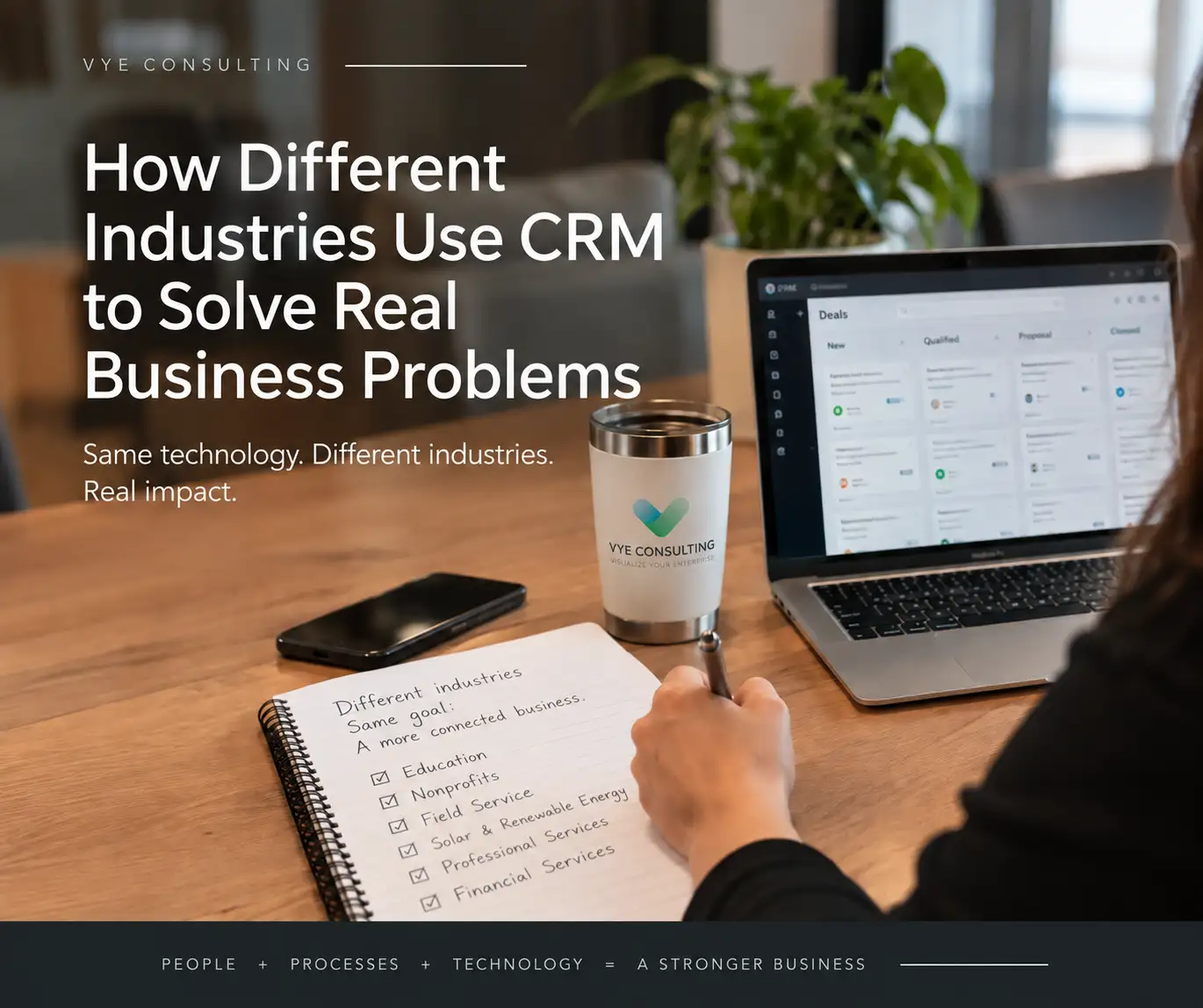
How Different Industries Use CRM to Solve Real Business Problems
VYE Consulting Team · CRM Strategy
When most people hear “CRM,” they think sales. But CRM for different industries looks nothing alike.
Leads come in. Sales reps follow up. Deals move through a pipeline. Someone runs a report at the end of the month.
And yes, CRMs absolutely do all of that. But that’s only scratching the surface.
We’ve worked with businesses across very different industries and one thing we’ve learned is that no two companies use their CRM exactly the same way. A college doesn’t operate like a solar company. A nonprofit doesn’t have the same processes as a field service business. And a professional services company may need something completely different from all of them.
That’s kind of the point.
Whether you’re using Salesforce, HubSpot or another CRM platform, the system should support the way your business actually operates, not force your business into a process that doesn’t make sense.
So, how do different industries use a CRM?
Education: Managing More Than Just “Leads”
In education, the people moving through your CRM aren’t necessarily traditional sales leads.
They may be prospective students, applicants, current students, alumni, employers, community partners, or some combination of all of the above.
We’ve worked with higher education organizations where CRM touches multiple parts of the student journey. That can include managing prospective students, tracking applications, automating communications, supporting multiple campuses, and connecting the CRM with other systems the institution already relies on. For example, we’ve integrated CRM systems with Canvas, allowing student information and activity to flow between the CRM and the platform students use for coursework, assignments, exams, and tracking their academic progress.
The CRM can also give different departments a more complete view of the same person without everyone maintaining their own spreadsheet or disconnected list.
And anyone who has ever tried to figure out which version of a spreadsheet is the “right” version knows why that matters.
The goal isn’t to turn student recruitment into a traditional sales process.
It’s to use CRM technology to make the institution’s existing processes easier to manage and give its teams better access to the information they need.
Nonprofits: Relationships Don’t Always Equal Revenue
Nonprofits are another great example of why CRM can’t be approached with a “one size fits all” sales mentality.
A nonprofit may need to manage donors, volunteers, program participants, fundraising efforts, grants, events, and communications, or all of those at once. The “relationship” in customer relationship management looks very different here.
We’ve helped nonprofit organizations move away from spreadsheets and disconnected systems and into CRM environments where information can actually live in one place.
That might mean tracking donor relationships, automating communications, integrating website forms, managing programs, or creating reporting that gives leadership a clearer picture of what’s happening across the organization.
The technology may be sophisticated behind the scenes, but the experience for the people using it shouldn’t have to be.
Field Service: Connecting the Office and the Field
For field service businesses, CRM can extend far beyond managing a sales pipeline.
Think about a company that has employees working at customer locations every day.
The business may need to manage customer information, properties or locations, work orders, service history, recurring maintenance, technician schedules, equipment, and follow-up, all while keeping the office and field teams working from the same information.
We’ve worked with businesses where technicians need access to the right information while they’re out in the field, while the office needs visibility into what’s happening without calling someone every five minutes for an update. That’s where a well-designed CRM and field service process can make a huge difference.
The goal isn’t simply to store customer information. It’s to keep the entire process moving.
Solar and Renewable Energy: Following a Customer Beyond the Sale
Solar is a great example of an industry where “Closed Won” isn’t necessarily the end of the process.
It might actually be closer to the beginning.
After a customer signs, there can still be multiple stages involving documentation, approvals, installation, project management, communication, and other teams or systems.
A CRM can help manage that entire journey.
We’ve worked with solar and renewable energy companies where CRM is used to manage leads and sales while also supporting the operational processes that happen after the deal closes. Automation can move information between teams, trigger tasks and communications, and help make sure important steps aren’t missed as a project progresses.
Because getting the sale is great.
Actually delivering what you sold is kind of important too.
Professional Services and B2B: Understanding the Entire Relationship
For professional services and other B2B companies, CRM is often the central place for understanding what’s happening with a prospect or client.
That can include lead management, sales pipelines, proposals, contracts, client communications, referrals, ongoing services, renewals, and reporting.
But the real value comes when those pieces actually connect.
- When a new lead comes in, where did it come from?
- Who should follow up?
- What happens when it becomes an opportunity?
- What happens after the deal closes?
- Does another team need to take over?
- Are there tasks that should happen automatically?
A good CRM can remove a lot of the manual handoffs that tend to fall through the cracks.
It can also give leadership better visibility into what’s actually happening across the business instead of piecing together information from five different places.
Financial Services: Managing Relationships With More Context
Financial services organizations often have long-term client relationships and a lot of information surrounding those relationships.
CRM can help teams organize client information, track interactions, manage opportunities, automate internal processes, and give users a more complete picture of the relationship.
Depending on the organization, there may also be additional requirements around access, security, documentation, and the types of information different users should be able to see.
That’s an important reminder that CRM design isn’t only about what a system can do.
It’s also about what it should do for that particular business.
CRM for Different Industries: Why the Same Platform Looks Completely Different
This is one of the things we love about CRM consulting. Two companies can use the exact same platform and have completely different systems.
- One Salesforce environment might manage students.
- Another might manage fire inspections and service appointments.
- Another might manage donors.
- Another might manage a sales team and thousands of opportunities.
The same is true with HubSpot. One business may primarily use it for marketing and lead generation, while another builds its sales process, automation, customer communication, and reporting around it.
That’s why choosing a CRM, or deciding how to configure the one you already have, shouldn’t start with a giant list of features.
It should start with your business.
Choosing CRM for Different Industries Starts With the Business Problem
Before building anything, we like to ask questions.
- What are you doing manually today?
- Where are things falling through the cracks?
- Where is information being entered more than once?
- What do employees constantly have to ask someone else for?
- What information does leadership wish they had?
- What parts of the process are frustrating your team?
Those answers tell us much more than a feature checklist ever could.
From there, we can determine what should be automated, what should stay manual, what needs to integrate with another system, and how the CRM should be structured.
Sometimes Salesforce makes the most sense. Sometimes HubSpot makes the most sense. Sometimes the bigger issue isn’t the CRM at all, it’s the process surrounding it.
That’s why we don’t believe in forcing every business into the same CRM blueprint.
Your technology should fit your business. Not the other way around.
Look for a CRM built around what it can actually do for your team:
- ✓Gives every department a single source of truth
- ✓Automates follow-ups and internal handoffs
- ✓Connects to the other systems you already use
- ✓Tracks the full relationship, not just the sale
- ✓Surfaces the information leadership actually needs
- ✓Fits the way your business already operates
At VYE Consulting, we build CRM for different industries, working with businesses across all industries to build, optimize, and connect CRM systems around the way they actually operate. Whether that’s Salesforce, HubSpot, automation between multiple platforms, or figuring out why your current CRM isn’t doing what you thought it would, we start with the same question:
What problem are we actually trying to solve?
Because once you understand that,
the technology becomes a whole lot more useful.
Ready to Build a CRM That Actually Fits Your Business?
Whether you’re in education, nonprofit, field service, solar, professional services, or financial services, VYE Consulting starts with your business problem, not a feature list.